



 How circular design, waste valorisation and biomaterials science can intersect to create products that are both sustainable and desirable.
The Loopback bangle project demonstrates how cross-disciplinary collaboration can turn scientific innovation into a compelling, market-ready sustainability solution.
Led by Loopback, a social and environmental biomaterials company founded by jewellery designer and fashion strategist Ingrid Vink (Think Like Vink), and developed in partnership with the Bioeconomy Science Institute (formerly Scion), the project explores how biodegradable polymers and waste-derived pigments can disrupt conventional plastic use in fashion and beyond.
“Fundamentally, we’re bringing a creative fashion lens to a scientific project,” says Ingrid, who assembled a multidisciplinary founding team for Loopback, combining fashion, business, and sustainability expertise to complement the Bioeconomy Science Institute’s scientific capability.
“Cross-collaboration across industries forces everyone to think differently – it’s often under-estimated.”
At the heart of the project is PHA (polyhydroxyalkanoates), a biodegradable, non-toxic class of polymers produced through natural fermentation of plant-based sugars or oils. While PHA has been researched since the 1980s, its adoption has been limited by cost and aesthetics. The Bioeconomy Science Institute’s breakthrough was to enhance PHA desirability by naturally tinting it with pigments derived from waste streams—creating a material that is not only environmentally sound, but visually compelling.
Loopback’s initial vision was to showcase a fully sustainable and environmentally friendly resin-like material through a fashion object that could communicate innovation clearly and emotionally.
“Fashion is an incredibly powerful communication tool,” says Ingrid. “It’s visual, cultural, and it creates desire. If you can make sustainable materials desirable, you open the door to much wider change.”
The bangle was chosen as a simple yet expressive form that could highlight colour, texture and finish, while remaining scalable for manufacturing.
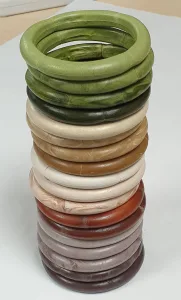
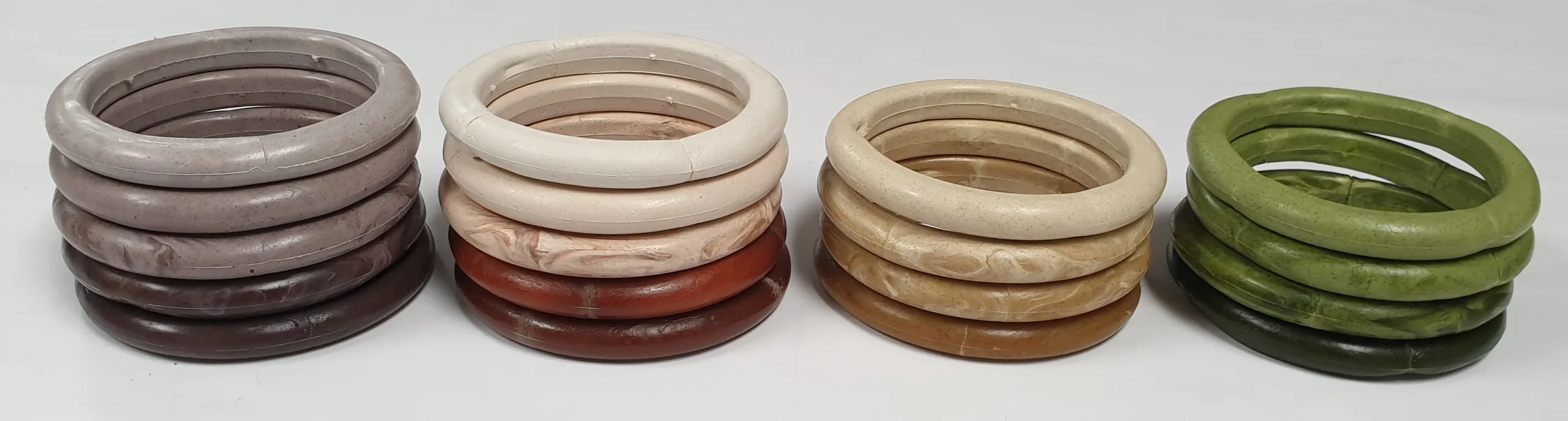
Bioeconomy Science Institute scientists, led by Senior Lab Technician Anna de Lena and High-value Biorefineries Portfolio Leader Stefan Hill, worked closely with Loopback to develop naturally pigmented PHA using materials such as grape marc (a by-product of winemaking), pine needles, pumpkin, spinach, beetroot, blueberry, walnut husk and tannins. These pigments are sourced from existing waste streams, require minimal processing, and produce stable, scalable colours. To date, the team has created six natural pigment formulations and produced approximately 500 prototype bangles in a range of hues and finishes.
“It’s very exciting – it’s a model of how a bioresource can be looped back into a sustainable, viable product,” says Anna.
The Loopback project has also explored multiple manufacturing pathways. The Bioeconomy Science Institute successfully produced PHA filament for 3D printing and pellets for injection moulding, enabling rapid prototyping and assessment of different forms. As the project matured, focus shifted toward injection moulding as the most viable route for scale. This led to investment in a prototype purpose-built mould for the Bioeconomy Science Institute’s lab-scale injection moulder—an important milestone that signals readiness for real-world application.
Loopback hopes to have the bangle ready to showcase commercially towards the end of 2026, on completion of the next phase with the Bioeconomy Science Institute where they will refine the finishes of the coloured formulations and complete degradation testing.
Collaboration has been central to the project’s success.
Funding and support from the Bioresource Processing Alliance (BPA), alongside contributions from the MacDiarmid Institute for Advanced Materials and Nanotechnology at Victoria University, helped accelerate pigment development and material testing with PhD graduate and Chemical and Process Engineer Dana Stone an integral part of this work.
“This project has been great as I’ve always loved learning and problem-solving,” says Dana, whose PhD research focused on the nano-micro scale of materials.
“The Loopback bangle product is unique due to its versatility — we were successful in tweaking the colour, uniformity, shade and opacity, allowing it to be utilised more broadly,” she says.
“Also, to have the pigments sourced from locally available waste streams means these products are both socially grounded and sustainable.”
While the Loopback bangle is the debut product, its ambitions extend far beyond jewellery. The project positions high-end fashion as a launch platform for new biomaterials that could later be adopted in high-end packaging, children’s toys, textiles and other applications where biodegradability and non-toxicity are critical.
“Jewellery alone won’t save the world,” says Ingrid, “but it can disrupt an industry, shift perception, and help launch a new material.
“We’re very excited about its potential.”
Interested commercial partners should contact Ingrid Vink (Think Like Vink) to discuss potential opportunities.
Comments are closed.